The Continuity Error That Is Not a Story Clue
Learn how to read a continuity error without mistaking it for a story clue, separating what the edit shows from what the film gives you reason to infer.
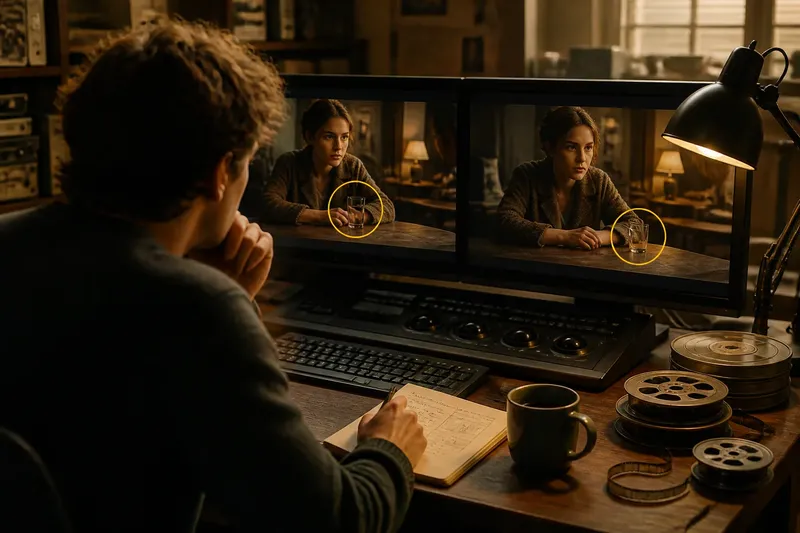
A continuity error is not, by itself, a story clue. In film editing, a continuity error is a visible or audible mismatch between shots that appear to belong to the same moment, such as a glass changing position between cuts. The mismatch is an observation; treating it as a deliberate signal is an interpretation that needs further support.
That distinction can be hard to keep while watching a carefully constructed film. A cut directs attention, and an unusual detail may seem charged with meaning. A grounded reading starts by describing what changes, then asks whether the film gives that change a clear purpose beyond the editing seam.
Why does a small mismatch feel meaningful?
Film encourages viewers to connect adjacent images. If a character reaches for a cup and the next shot shows the cup closer to the edge of the table, the cut invites a sense of continuity, even if the positions do not quite match. Our attention naturally looks for an explanation when the sequence breaks that expectation.
Storytelling strengthens the impulse. A film may use repeated objects, gestures, or colors as motifs, so a changed detail can seem to belong to that visual pattern. But resemblance is not enough: an object appearing in two shots does not automatically make every difference between its appearances intentional symbolism.
Start with the plain description: “The cup is nearer the edge in the second shot.” That sentence records what is visible without claiming why it happened.
What should you do when you spot a mismatch?
Work in order, from observation toward interpretation. This keeps an interesting possibility from turning into a conclusion before the sequence supports it.
- Name the changing detail. Identify the object, gesture, position, costume, or sound that differs. Be specific enough that another viewer could look for the same change.
- Check the surrounding cuts. Ask whether the shots seem to cover the same continuous action or whether time, place, or viewpoint has shifted. A difference across a clear transition may be ordinary storytelling, not an error.
- Describe the sequence without explaining it. Note who is present, what each person does, and what the film shows before and after the mismatch. Leave words such as “symbolizes” or “foreshadows” out for now.
- Look for a practical production explanation. Consider whether the shots may have been filmed separately, whether an actor reset a gesture, or whether a prop was moved between takes. These possibilities explain how a mismatch could arise, but do not establish what happened behind the scenes.
- Ask what the story makes of it. Does a character notice the change? Does the film return to it, connect it to a later event, or use it to alter the scene’s meaning? If not, keep the interpretation tentative.
Say you notice that a character’s coat is buttoned in one shot and open in the next during a conversation. You record the change, check whether the conversation appears uninterrupted, and see that nobody reacts and the film does not return to the coat. A reasonable reading is that the shots do not match; calling the coat a clue would require more evidence.
Could the mismatch come from how the scene was made?
Often, a continuity mismatch can be explained by the practical demands of shooting and editing. Scenes are commonly assembled from separate takes and camera angles rather than captured as one uninterrupted event. Actors may repeat an action, and small details such as hand position, a sleeve, or the level of a drink can differ between takes.
Editors choose among available shots to preserve pacing, performance, and clarity. A cut that keeps the strongest line reading may leave a small prop shift visible. That does not prove the shift was accidental, but it gives a straightforward reason not to assume that every mismatch carries a hidden message.
There is also a difference between continuity and consistency. Continuity describes whether neighboring shots appear to fit together; consistency concerns whether details remain stable across a scene or film. A detail may be inconsistent without disrupting the action, while a continuity break can briefly distract the viewer even when the plot remains clear.
How can you separate observation from interpretation?
Use language that marks the difference between evidence and inference. “The lamp is on in the doorway shot and off in the next shot” is an observation. “The lamp’s change means the character has entered a different state of mind” is an interpretation, and it needs support from the scene.
Then ask what evidence would make that interpretation more convincing. The film might emphasize the lamp with repeated framing, connect its state to a character’s decision, or show someone deliberately switching it. If none of those things happens, the symbolic reading may be possible, but it is not the only or most grounded explanation.
Try a simple three-column note while rewatching:
- What I see: the exact mismatch, stated neutrally.
- What the scene supports: actions, reactions, dialogue, or repeated visual emphasis.
- What I am inferring: a possible meaning, marked as uncertain.
This separation does not drain a film of ambiguity. It lets you keep an imaginative reading without confusing it with something the edit clearly establishes.
When is a mismatch more likely to be intentional?
Intentional choices usually have some support in the film’s form or story. A mismatch may be worth interpreting when the film draws attention to it, repeats it in a pattern, or makes it affect what a character knows or does. The strongest clue is not merely that a detail changed, but that the sequence gives the change a role.
Even then, distinguish a deliberate visual effect from a specific plot revelation. A jump in a character’s position might create a moment of unease without indicating that time has literally shifted. The effect can be purposeful while the viewer’s proposed explanation remains uncertain.
Compare the mismatch with nearby details. If other continuity breaks cluster around a moment of disorientation, the film may be making the scene feel unstable. If only one cup moves slightly and the scene proceeds without emphasis, a production mismatch is a simpler account.
What questions help you judge a continuity error?
Does every continuity error have a hidden meaning?
No. Some mismatches result from separate takes, prop resets, or editing choices that favor other parts of a scene. Treat meaning as a possibility to assess, not a property automatically attached to every inconsistency.
How can I tell a continuity error from a time jump?
Look at the scene around the change: a new location, altered lighting, a change in action, or an explicit transition can signal that time has passed. A difference between shots alone does not establish a jump, so consider the sequence as a whole.
Can an accidental mismatch still affect the scene?
Yes. A visible break can distract a viewer or create an unintended impression, even if it was not designed as a symbol. Its effect on your experience is real, but that effect does not prove a particular intention.
Should I trust a continuity explanation from a production source?
A production account can add useful context about how a scene was made, but it does not replace what the finished film shows. Keep the account distinct from your own reading of the edit, especially when the film leaves the meaning open.
What should you do when the evidence stays unclear?
Keep the observation and leave the cause open. You can say that the detail changes and that the film does not make the change’s significance clear. That is a complete reading, not a failure to solve a puzzle.
If the mismatch continues to interest you, compare it with the film’s broader patterns without forcing a connection. A repeated motif or a later character reaction may give you a reason to revise your interpretation; in their absence, the careful answer is simply that the edit contains a mismatch.
The most useful habit is to keep “what changed?” separate from “what does it mean?” A continuity error is not a story clue unless the film gives you a reason to read it that way.